New Measures Target Deliberate Non-Payment of Electricity Bills in Greece
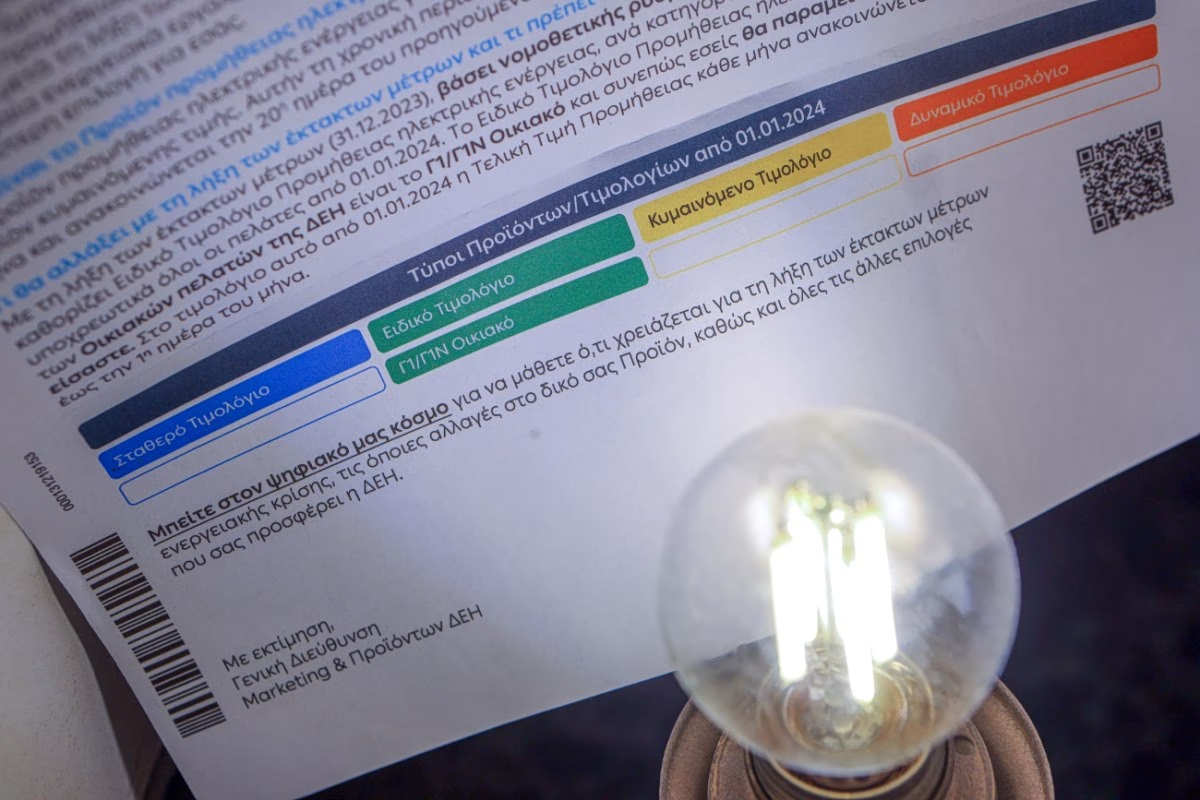
Greek energy authorities are preparing to introduce a formal system for flagging consumers who consistently and deliberately fail to pay their electricity bills. The initiative, spearheaded by the Ministry of Energy, draws inspiration from the Teiresias system — the credit reference bureau widely used in the Greek banking sector to track individuals with outstanding loan obligations and financial defaults.
The move signals a significant shift in how energy providers and grid operators handle overdue accounts, particularly in cases where non-payment appears to be a calculated choice rather than a reflection of genuine financial hardship. Officials have drawn a clear distinction between households struggling to meet their bills due to economic difficulty and those who are deemed capable of paying but choose not to do so.
What the Proposed System Would Involve
Under the proposed framework, overdue electricity debts would be recorded and flagged through a dedicated marking system operated in connection with the Hellenic Electricity Distribution Network Operator, known by its Greek acronym DEDDIE. This operator manages the country's low- and medium-voltage electricity distribution network and is responsible for a substantial portion of consumer connections across Greece.
The flagging mechanism would essentially create a registry of delinquent accounts, enabling energy suppliers and relevant authorities to identify patterns of repeated non-payment. The core objective is to differentiate between consumers who genuinely cannot afford to pay and those classified as strategic defaulters — individuals or entities who have the financial means to settle their bills but deliberately withhold payment.
By introducing this classification, authorities hope to apply targeted pressure on the latter group while ensuring that vulnerable consumers are not subjected to the same penalties or reputational consequences. The precise operational details of how the system will distinguish between these categories have not yet been fully disclosed, but consultations are reportedly ongoing with stakeholders across the energy sector.
The Problem of Strategic Defaulters in the Energy Sector
The issue of unpaid electricity bills has been a persistent challenge for energy suppliers and network operators in Greece. While economic downturns and energy poverty have contributed to rising arrears in past years, a portion of outstanding debts is attributed to consumers who exploit gaps in the enforcement system to avoid payment without immediate consequence.
Strategic defaulters — a term borrowed from the banking world, where it was widely used during the Greek financial crisis to describe mortgage holders who stopped paying loans despite having sufficient assets — have become an increasing concern in the utilities sector as well. Energy companies have reported difficulties in recovering overdue amounts, particularly when formal enforcement mechanisms are limited or slow-moving.
The introduction of a centralized flagging system is intended to add a new layer of accountability. Much like the Teiresias system discourages loan defaults by affecting a borrower's creditworthiness and access to future financing, a similar mechanism in the energy sector could serve as a deterrent by associating unpaid electricity debts with a consumer's broader financial profile.
Broader Context: Energy Debt and Consumer Protection
Greece has made notable efforts in recent years to balance the protection of vulnerable energy consumers with the financial sustainability of suppliers and network operators. Programs such as the Social Household Tariff have provided subsidized electricity rates to low-income households, while disconnection protections have shielded certain groups from having their power cut off during winter months.
However, these protections have also, in some cases, been exploited by consumers who do not qualify under the intended criteria. Authorities have acknowledged that tightening oversight and introducing more robust tracking mechanisms are essential to maintaining the integrity of support programs and ensuring that resources are directed toward those who genuinely need them.
The proposed flagging system aligns with a broader regulatory trend across European Union member states, where energy regulators are increasingly seeking data-driven tools to monitor consumer behavior, manage systemic risks, and improve collection rates without resorting to blanket disconnection policies that can harm vulnerable populations.
Reactions and Concerns
While the initiative has not yet prompted a full public debate, it is expected to raise questions from consumer advocacy groups about data privacy, the accuracy of the flagging criteria, and the potential for errors that could unfairly penalize households experiencing temporary financial difficulties. Critics of similar systems in the banking sector have pointed to the risk of stigmatization and the challenges individuals face when trying to contest or clear erroneous records.
Proponents, on the other hand, argue that without effective deterrents, the financial burden of unpaid bills is ultimately passed on to other consumers through higher tariffs and reduced investment in grid infrastructure. They contend that a well-designed flagging mechanism, with appropriate safeguards and appeal processes, is both fair and necessary.
Next Steps
The Ministry of Energy is expected to issue a formal decision outlining the structure and operational parameters of the new system. The decision will likely specify how overdue debts will be recorded, the threshold at which a consumer is flagged, the duration for which a flag remains active, and the process by which consumers can dispute their classification.
DEDDIE, as the network operator most directly affected by collection issues at the distribution level, is anticipated to play a central role in implementing and maintaining the registry. Coordination with energy suppliers, the Regulatory Authority for Energy, and possibly financial sector bodies will be necessary to ensure that the system functions effectively and within the existing legal framework governing both energy regulation and personal data protection.
As Greece continues to modernize its energy infrastructure and align with European standards, measures aimed at improving payment discipline among consumers capable of meeting their obligations are likely to remain a priority for policymakers. The outcome of this initiative could set an important precedent for how utility debt is managed in the country going forward.