Continental Football Confederations Move Against FIFA's Infantino
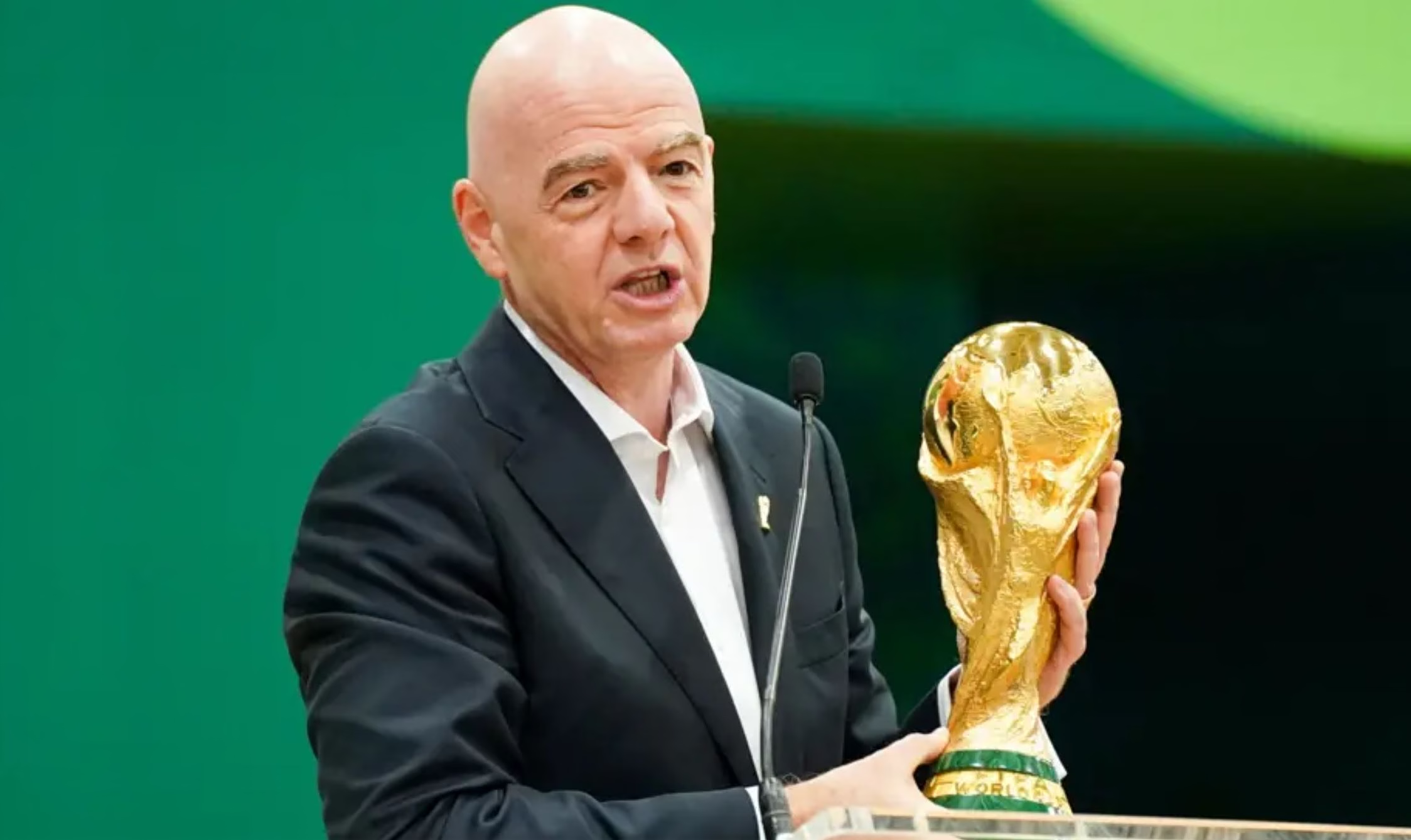
A coordinated effort is reportedly underway among several of the world's most powerful continental football organizations to force FIFA President Gianni Infantino out of his position at the helm of world football's governing body. According to reports, the European football confederation UEFA, the Asian Football Confederation (AFC), and the Confederation of North, Central America and Caribbean Association Football (CONCACAF) are preparing a formal motion of no confidence against the longtime FIFA chief.
If confirmed, the move would represent one of the most significant internal challenges to Infantino's authority since he first assumed the FIFA presidency in 2016, following the resignation of Sepp Blatter amid a sweeping corruption scandal that rocked the organization to its core. The coordinated nature of the reported opposition — spanning three continents — suggests that dissatisfaction with Infantino's leadership has reached a critical threshold among key stakeholders in the global game.
A Coalition Spanning Three Continents
The three confederations involved in the reported effort represent a substantial portion of both FIFA's membership and the global football audience. UEFA alone encompasses 55 member associations across Europe, making it one of the most commercially powerful and politically influential bodies in world football. The AFC similarly covers a vast and growing football market stretching from Central Asia to East Asia and the Pacific region, while CONCACAF oversees football development and competition across North America, Central America, and the Caribbean.
Together, these organizations represent hundreds of FIFA member associations and billions of football fans worldwide. Their combined weight within FIFA's internal governance structures means that a formal motion backed by all three could carry significant procedural consequences, potentially placing Infantino's future in the role in serious jeopardy.
Background: Infantino's Tenure Under Scrutiny
Gianni Infantino has led FIFA since early 2016, a period during which the organization has pursued a number of high-profile and at times controversial initiatives. Among the most prominent of these was the expansion of the FIFA World Cup from 32 to 48 teams, a format change that debuted at the 2026 tournament co-hosted by the United States, Canada, and Mexico. Infantino has also championed the Club World Cup expansion and pursued new broadcasting and commercial partnerships as part of a broader strategy to increase FIFA's revenues and global reach.
However, his tenure has not been without controversy. Critics have pointed to concerns about governance transparency, the concentration of decision-making power within FIFA's executive structures, and questions about the organization's relationships with certain member federations and commercial partners. Infantino has also drawn scrutiny over his personal conduct and public statements on a range of sensitive topics, drawing criticism from players, officials, and civil society groups alike.
UEFA's Long-Standing Tensions with Infantino
Tensions between Infantino and UEFA — the confederation he previously served as General Secretary before moving to FIFA — have simmered for several years. European football's governing body has at various points expressed concern over FIFA's commercial direction, the scheduling of international competitions, and what some European officials have characterized as an erosion of the confederations' influence within FIFA's broader governance framework. The reported decision to back a motion of no confidence would mark a dramatic escalation of those tensions.
AFC and CONCACAF's Role in the Opposition
The involvement of AFC and CONCACAF in the reported coalition adds further weight to the challenge facing Infantino. While both confederations have historically maintained varying degrees of alignment with FIFA leadership, their reported participation in this effort suggests that concerns about the current administration's direction extend well beyond Europe. The specific grievances driving AFC and CONCACAF's reported participation have not yet been fully detailed in public reporting, though broader issues of governance, revenue distribution, and FIFA's strategic priorities are understood to be central to the discussions.
What a Motion of No Confidence Would Mean
A formal motion of no confidence against a sitting FIFA president is a rare and consequential procedural step. FIFA's governance statutes outline specific mechanisms for challenging or removing an elected official, and any such process would likely require engagement from a broader coalition of FIFA's 211 member associations beyond the three confederations currently reported to be involved.
For a motion to succeed in formally removing Infantino from his position, it would need to command sufficient support at either a FIFA Congress or through the FIFA Council, depending on the specific procedural route pursued. This means that the confederations pushing the effort would need to build a wider coalition of support among member associations across Africa, South America, and Oceania — regions whose confederations have not yet been reported as part of the current opposition effort.
CONMEBOL, the South American confederation, and CAF, the African confederation, would likely play pivotal roles in determining whether such a challenge could achieve the numerical support necessary to succeed. Their current positions on the matter remain unclear based on available reporting.
Implications for Global Football Governance
Regardless of the ultimate outcome, the reported push against Infantino highlights the ongoing tensions that characterize FIFA's internal politics and raises fresh questions about the governance of world football at the highest level. The organization has spent much of the past decade attempting to rebuild its reputation following the corruption crisis of the mid-2010s, and a prolonged leadership dispute could complicate those ongoing efforts.
For football fans and stakeholders worldwide, the situation serves as a reminder that the structures governing the sport at the global level remain subject to intense political pressures and competing interests. How the various confederations and member associations navigate the coming weeks and months is likely to shape the direction of FIFA — and world football more broadly — for years to come.
As of now, FIFA has not issued an official response to the reports of a coordinated motion of no confidence being prepared against Infantino. Further developments are expected as the situation continues to unfold within the corridors of football's global power structures.