What is the NASA Perseverance rover's recent achievement?
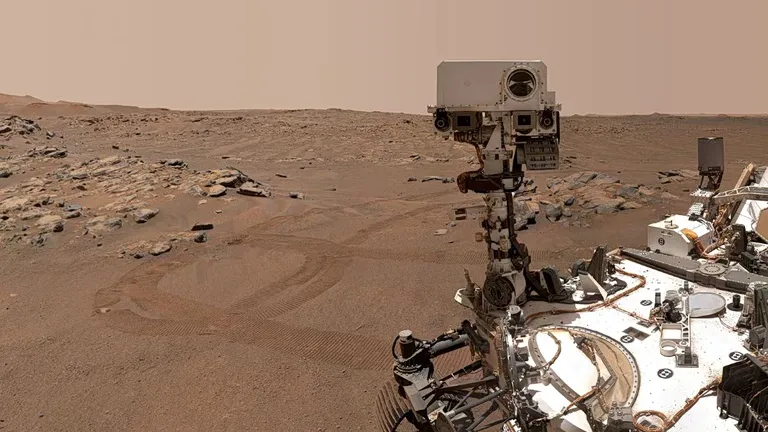
The NASA Perseverance rover recently set a new record for the longest distance driven by a rover on Mars, reaching 45.22 kilometers on October 11, 2026. This achievement surpasses the previous record of 45.16 kilometers held by the Opportunity rover. The Perseverance rover, which landed on Mars in February 2021, accomplished this feat in less than six years, demonstrating its advanced capabilities in autonomous navigation.
How does the Perseverance rover navigate on Mars?
The Perseverance rover employs a sophisticated autonomous navigation system known as AutoNav. This system captures stereoscopic images of the Martian terrain, constructs a 3D map, and selects the safest route to its destination. Additionally, the Vision Compute Element, a specialized co-processor, allows the rover to process images and execute navigation software continuously while in motion. These technologies have enabled Perseverance to traverse challenging terrains efficiently.
What scientific discoveries has Perseverance made?
One of the most significant scientific achievements of the Perseverance rover is the discovery of a potential biosignature, which may indicate ancient microbial life. This discovery was made in a reddish rock believed to be 3.2 to 3.8 billion years old, located in a river channel that once fed a lake in Jezero Crater. The rover's mission includes searching for evidence of ancient microbial life and collecting rock and soil samples for potential future return to Earth.
Why is Jezero Crater significant for exploration?
Jezero Crater is a critical area for exploration due to its geological history. It is believed to have been flooded with water and hosted a lake billions of years ago. The crater's sediments may provide insights into early planetary geological processes and the impact of meteorite collisions. These factors make Jezero Crater an ideal location for studying Mars's past environments and the potential for ancient life.
What is the future of the Perseverance rover's mission?
The Perseverance rover's mission has been extended by NASA to continue exploring the rim of Jezero Crater until approximately the end of 2028. The rover's plutonium-based power system is functioning as expected, providing ample energy for continued exploration. Future plans include investigating areas that may have been hydrothermal systems with warm or hot underground waters, which could have supported life. These explorations aim to uncover more about Mars's potential habitability.
FAQ: NASA Perseverance Rover
What is the primary goal of the Perseverance rover?
The primary goal of the Perseverance rover is to search for signs of ancient microbial life and collect samples for potential return to Earth.
How does the Perseverance rover differ from previous Mars rovers?
Perseverance features advanced autonomous navigation and scientific instruments, allowing it to explore Mars more efficiently and conduct in-depth scientific analyses.
What is AutoNav, and how does it work?
AutoNav is an autonomous navigation system that enables the rover to drive itself by creating 3D maps of the terrain and selecting safe routes.
Why is Jezero Crater an important exploration site?
Jezero Crater is significant because it may have hosted a lake and hydrothermal systems, offering clues about Mars's past environments and potential life.
What are the implications of finding a potential biosignature on Mars?
Discovering a potential biosignature suggests that Mars may have once supported life, providing insights into the planet's history and the possibility of life beyond Earth.
Key takeaways
- The Perseverance rover set a new driving record on Mars with 45.22 kilometers.
- Advanced autonomous navigation systems enable efficient exploration.
- Potential biosignature discovery suggests ancient microbial life.
- Jezero Crater offers insights into Mars's geological history.
- The mission is extended to explore potential hydrothermal systems.
Conclusion
The NASA Perseverance rover's achievements on Mars mark a significant milestone in space exploration. Its record-breaking drive and potential discovery of ancient microbial life highlight the importance of advanced technology in uncovering Mars's secrets. As the mission continues, Perseverance will further explore Jezero Crater, providing valuable insights into the planet's past environments and the possibility of life beyond Earth. These findings could reshape our understanding of Mars and its potential habitability.